Ductless Mini-Split vs Central AC for an Addition: Which Makes Sense?
August 7, 2026
QUICK ANSWER: For most additions, a ductless mini-split is the simpler and more efficient path because it skips the need to tie new ductwork into a system that may not have the capacity to handle it. A mini-split gives the new space its own zone, its own thermostat, and installation that only requires a small line set through an exterior wall. Extending your central system can still work if your existing unit has spare capacity and the duct run to the addition is short and reasonable to install, but that has to be confirmed rather than assumed. The right call depends on how your current system is sized, how far the addition sits from your existing ductwork, and how much independent control you want over that room.
You are finally building out that sunroom, converting the garage, or framing in a bonus room over the porch, and somewhere in the middle of the project the question comes up: how is this space going to stay comfortable in a Tennessee summer or a January cold snap? Your contractor mentions running new ductwork off the existing trunk line. Someone else suggests just putting in a mini-split. Both are real options, and both can work, but they solve the problem in very different ways and one of them usually fits your specific addition better than the other.
This is one of the more common questions homeowners bring to an HVAC technician once framing is underway. It depends on the house behind the new walls, not just the new room itself. Here is how to think through it before the drywall goes up.
Why This Decision Comes Down to Your Existing Ductwork
The core difference between the two options is simple. A mini-split is a self-contained heating and cooling unit for that one room or zone, with its own indoor head and its own line set running to an outdoor condenser. Extending central air means tying new duct runs into your existing system so the same blower and same outdoor unit now condition the addition along with the rest of the house.
That distinction matters because your existing central system was sized for the house as it exists today. Add square footage to the duct network and you are asking that same blower and condenser to move more air and remove more heat without necessarily giving it more capacity to do so. A mini-split sidesteps that question entirely because it brings its own capacity with it, sized just for that room. Neither option is automatically better. It comes down to what your current system can actually absorb.
What a Mini-Split Brings to a New Room
Its own zone, its own comfort. The addition gets its own thermostat and its own compressor cycling independently of the rest of the house. If the sunroom runs hotter in the afternoon sun or the bonus room over the garage never quite matches the rest of the house, a mini-split lets you set that space exactly where you want it without overcooling or overheating everything else to compensate.
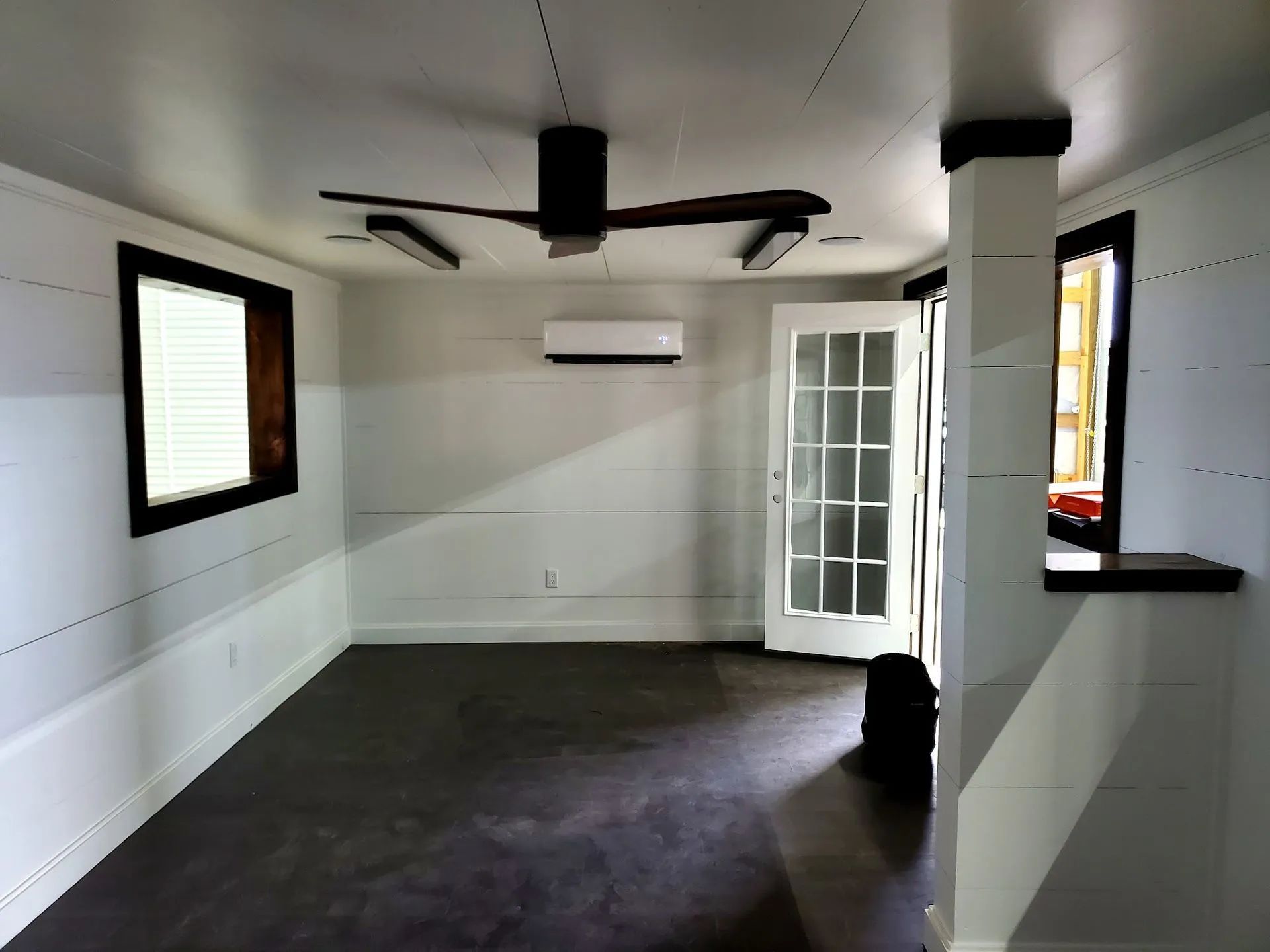
Installation that barely touches the rest of the house. A mini-split needs a mounting location for the indoor head, a spot for the outdoor condenser, and a small opening through the wall for the line set and drain. There is no cutting into ceilings or floors to run ductwork, no rerouting around joists, and no disruption to rooms outside the addition. For a finished addition where the walls are already closed up, that is often the deciding factor by itself.
Efficiency that does not depend on ducts. Because a mini-split delivers conditioned air directly into the room rather than through a network of ducts, it avoids the energy losses that come with duct runs, including leaks at joints, poorly sealed connections, and heat gain or loss as air travels through an unconditioned attic or crawlspace. Newer mini-split systems built with inverter-driven compressors also modulate their output to match the actual load in the room instead of cycling on and off at full blast, which keeps the temperature steadier and reduces wear on the equipment.
Heating and cooling from one system. Most residential mini-splits installed today are heat pumps, meaning the same unit handles both sides of the year. For an addition that will get used through all four seasons, that is one piece of equipment doing the whole job instead of relying on space heaters in winter.
What Extending the Central System Actually Involves
Running new ductwork to an addition is not simply cutting a hole in the trunk line and adding a vent. It starts with checking whether your existing furnace or air handler and outdoor condenser have any spare capacity left. If the system was sized tightly for the current square footage, adding a room to that same loop can leave the whole house running longer to keep up, and the new space may end up as the room that never quite reaches temperature.
The duct run itself matters too. A short, direct path from existing ductwork to the addition with room to route through an attic or crawlspace is a very different job than snaking new ducts through finished walls or across long horizontal runs. Static pressure, meaning how hard the blower has to work to push air through the whole system, climbs with every extra foot of duct and every added vent, and a system pushed past its designed static pressure loses efficiency and can shorten the equipment's life.
TIP: Before you commit to either option, ask whoever is bidding the job to actually check your existing system's capacity and run a room-by-room load calculation for the addition rather than eyeballing it. A proper Manual J style load calculation accounts for the addition's square footage, window area, insulation, and orientation to the sun, and it is the only way to know honestly whether your current unit has room to spare or whether a mini-split's own capacity is the safer bet.
When Extending the Ducted System Still Makes Sense
None of this means a mini-split wins by default. If your existing HVAC system was installed with future growth in mind, or if it is oversized relative to your current square footage, tying the addition into the existing ductwork can work well and keeps everything running off one thermostat. It also keeps the room's appearance consistent with the rest of the house, with vents in the floor or ceiling instead of a wall-mounted head.
Extending ductwork tends to make the most sense when the addition sits close to existing trunk lines, when there is accessible space to route new ducts without tearing into finished surfaces, and when a load calculation confirms the current equipment can handle the extra square footage without straining. In those situations, one system and one thermostat for the whole house is a reasonable trade against the flexibility a mini-split offers.
Where the Efficiency Numbers Actually Land
Industry testing consistently shows ductless systems posting higher efficiency ratings than ducted central systems, with some ductless models reaching SEER2 ratings in the mid-30s while high-efficiency central systems typically top out well below that. Part of that gap comes directly from the ductwork itself. The Department of Energy has noted that duct losses can account for more than 30 percent of the energy used for heating and cooling in a typical home, mostly from air escaping through leaky joints and heat transferring through ducts that run outside the conditioned space. A mini-split never has that loss to begin with, because the conditioned air goes straight from the unit into the room.
That efficiency gap is one reason a mini-split often makes more financial sense over the life of the equipment even when the ducted option looks simpler on paper, though the honest answer is that it depends on how far the new duct run has to travel and how tight your existing system's capacity already is.
Getting the Sizing Right, Either Way
Whichever direction you go, the addition needs to be sized on its own merits, not guessed at based on square footage alone. A room with west-facing windows and a cathedral ceiling holds heat very differently than an interior room with standard eight-foot ceilings, and oversizing the equipment causes its own problems. An oversized mini-split or an oversized central system cycles on and off too quickly, cools or heats the air without adequately controlling humidity, and wears out its components faster from constant short cycling.
For a mini-split, that means matching the indoor head's BTU rating to the room's actual heat gain and loss, not just picking the biggest unit available. For a ducted extension, it means confirming the blower can move enough air through the new run at a static pressure the system was designed to handle. Either path benefits from a technician walking the space, measuring window area and insulation, and calculating the real load before any equipment gets ordered.
WARNING: Do not let anyone talk you into oversizing the equipment as a way to play it safe. A mini-split or a central system that is too large for the addition cools the room quickly but shuts off before it has run long enough to pull humidity out of the air, leaving the space feeling clammy even at the right temperature. That constant short cycling also puts more wear on the compressor over time than a correctly sized system running full, steady cycles. Bigger is not a safety margin here, it is a different problem waiting to show up on the first humid afternoon.
Is it safe to mount a TV over a fireplace?
Yes, with the right precautions. Heat off the firebox, wall structure, and viewing angle all need checking first. A gas or electric unit with managed heat can run for years. Wood-burning fireplaces with no heat plan cause trouble.
How far above the fireplace should the TV be mounted?
A common range is 8 to 12 inches between mantel top and screen bottom, though it shifts with your fireplace and wall height. The hotter the unit, the more clearance you want, keeping the screen above rising heat.
Can the heat from my fireplace really damage a TV?
It can, usually slowly. Most sets are rated up to 100-104 degrees, and unmanaged fireplace walls can climb past that. Over time this shows as dead pixels, a warped bezel, or shutdowns. Managing heat prevents it.
Do I need a special mount for a TV over a fireplace?
Most of the time, yes. A fixed mount aims the screen over your head. A tilting mount angles down toward viewers; full-motion arms pull out and down. The right choice depends on screen size and wall height.
Can I hide the wires if my fireplace is brick or stone?
It's harder than drywall but doable. Masonry rarely has an open cavity, so the path must be planned before mounting. Options range from in-wall routing to low-profile surface channels. Mapping the route first avoids disruptive retrofits.
Should the TV be bigger or smaller than the fireplace?
As a rule, match the firebox width or go slightly smaller, keeping the wall balanced. Oversized panels over narrow hearths are common now, but proportion makes the wall read as one clean focal point, not competing elements.
Frequently Asked Questions
Is a mini-split cheaper to run than extending central air to an addition?
In most cases, yes, largely because a mini-split avoids duct energy losses and its inverter-driven compressor adjusts output to match the room's actual load. The gap widens with longer or less accessible duct runs.
Can I add a mini-split even though the rest of my house has central air?
Yes. A mini-split operates as its own independent system and doesn't need to connect to existing ductwork or thermostats. Many homes run central air for main living space plus a mini-split for a converted room.
Will extending my ductwork make the rest of my house less comfortable?
It can, if the existing system lacks spare capacity. Adding square footage to the same duct network without confirming blower and condenser capacity may mean longer run times and less consistent temperatures throughout the house.
Does a mini-split heat as well as it cools?
Most residential mini-splits installed today are heat pumps built to handle both seasons, and modern units maintain strong heating performance even in cold outdoor temperatures. For a year-round addition, one system covers everything.
How do I know if my current system can handle a duct extension?
A load calculation on the addition combined with a capacity check on your existing furnace or air handler and outdoor unit is the only reliable way to know for certain.
Choosing the Right Fit for Your Addition
The choice between a ductless mini-split and extending central air isn't about which system sounds more modern or more traditional. It comes down to what your existing equipment can actually support and how much independent control you want over the new space. A mini-split offers its own zone and minimal disruption to finished walls, while a duct extension can work well when there's spare capacity and a short, accessible run. Either path holds up when it's based on real numbers instead of assumptions.
That's exactly why a proper load calculation matters more than gut instinct here, since it accounts for window area, insulation, and ceiling height rather than square footage alone. Day's Heating & Air LLC, based in Cleveland, TN, brings 27+ years of experience to that evaluation, checking existing system capacity before recommending a direction. Whether the addition ends up with a dedicated mini-split or a well-planned duct extension, the equipment fits the room it's meant to serve.